Address
304 North Cardinal
St. Dorchester Center, MA 02124
Work Hours
Monday to Friday: 7AM - 7PM
Weekend: 10AM - 5PM
Address
304 North Cardinal
St. Dorchester Center, MA 02124
Work Hours
Monday to Friday: 7AM - 7PM
Weekend: 10AM - 5PM
Discover how advanced Design for Manufacturing (DfM), AI-driven material allocation, and optimized KD logistics systematically cut landed costs through smart Ottoman Manufacturing Cost Control.
In the highly competitive global furniture market, the primary challenge for international retailers, e-commerce brands, and wholesalers isn’t just finding an aesthetically pleasing product. The real challenge lies in securing a manufacturing partner who treats production efficiency as a science. At FZ Victor, a premier furniture manufacturer in China, we have spent years refining our supply chain and production lines. Our core mission relies on executing rigorous Ottoman Manufacturing Cost Control to ensure our B2B partners receive premium-quality products at a significantly lower landed cost.
Achieving a healthy profit margin in today’s economic climate requires more than just cutting corners; it demands strategic Ottoman Manufacturing Cost Control. Below is a comprehensive, inside look at how we optimize every stage of the manufacturing process to support your business’s bottom line through systematic Ottoman Manufacturing Cost Control practices. To learn more about our factory’s background and setup, you can visit our about us page.
Material costs typically account for 60% to 70% of the final factory-gate price of an upholstered ottoman. Therefore, any effective Ottoman Manufacturing Cost Control framework must begin right at the source—before a single piece of fabric is cut or a single nail is driven. Effective raw material selection forms the bedrock of long-term Ottoman Manufacturing Cost Control.
Many furniture factories rely on secondary brokers or local distributors to source their timber, foam, and textiles. This adds layers of unnecessary markups. FZ Victor bypasses these intermediaries entirely to enhance our Ottoman Manufacturing Cost Control results. By maintaining direct, long-term contractual relationships with major textile mills and sustainable timber yards verified by the Forest Stewardship Council (FSC) in the Fuzhou region, we secure raw materials at near-wholesale baseline prices to maintain strong Ottoman Manufacturing Cost Control.
The cost of trend-forward textiles—such as premium velvet, bouclé, and performance linen—is notoriously volatile. To protect our B2B clients from sudden market price spikes, we actively monitor textile trends and engage in bulk fabric purchasing as part of our overall Ottoman Manufacturing Cost Control protocol. We stock high-demand fabrics in our climate-controlled warehouses, stabilizing material costs for our clients’ recurring product lines throughout the fiscal year.
Manual fabric cutting is prone to human error and high scrap rates. At FZ Victor, we utilize automated CNC fabric cutting machines integrated with advanced AI nesting software to enforce strict Ottoman Manufacturing Cost Control:
Wood sourcing is another critical vector for Ottoman Manufacturing Cost Control. By implementing strict standardized sorting protocols for our solid wood and plywood frames, we eliminate knots and structural weaknesses before the lumber ever reaches the mill. This preemptive sorting prevents mid-production splitting, saving both raw lumber overhead and valuable labor hours to uphold total Ottoman Manufacturing Cost Control.

Engineered with precision steel frame mechanisms and high-density foam cores for corporate lounge installations.
View Specs
Premium cognac upholstery paired with solid hardwood frame geometry for hospitality suites.
View SpecsOne of the largest invisible drains on a B2B buyer’s profitability doesn’t happen inside the factory—it happens on the ocean. Shipping bulky, fully assembled furniture across continents can quickly erode your retail margins. This is where our specialized Design for Manufacturing (DfM) approach alters the financial equation, especially for our high-volume lines managed by an experienced KD ottoman manufacturer wholesale hub focused on Ottoman Manufacturing Cost Control.
Our internal Research and Development (R&D) team designs products with a structural focus on assembly efficiency. By engineering ottomans with detachable legs, modular frames, and smart-locking hardware, we transform a traditionally space-consuming item into a streamlined, flat-packed package. This engineering precision is crucial for robust Ottoman Manufacturing Cost Control during global shipping.
For multi-piece ottoman sets or storage benches, we implement “nested” concepts to push Ottoman Manufacturing Cost Control further. Smaller footstools are precision-sized to fit completely inside the hollow core of larger main units, a technique perfectly executed in our set of 2 ottomans production lines. When shipping storage ottomans, the internal storage cavity is never left empty; we use it to house hardware, legs, or smaller accent pieces, maximizing space just like a dedicated folding storage ottoman manufacturer wholesale expert executing strict Ottoman Manufacturing Cost Control.
To push our shipping efficiency further, our logistics specialists use 3D cargo loading software to simulate exact configurations inside 40ft HQ containers before boxing begins. We design box dimensions to correspond perfectly with standard container heights and widths, ensuring zero “dead space” and enhancing overall Ottoman Manufacturing Cost Control.
Total reliance on manual labor increases lead times and human error, while total reliance on automation can strip furniture of its premium texture and market appeal. Our blueprint for Ottoman Manufacturing Cost Control relies on a calculated, hybrid production model across all categories, including our specialized wholesale tray stools folding ottoman selection.
| Production Phase | Methodology Used | Operational Advantage | Cost & Quality Benefit |
|---|---|---|---|
| Frame Construction | Heavy Machinery & Automated CNC | Perfect structural dimensions; rapid output | Eliminates structural defects; lowers base labor costs |
| Foam Layering | Specialized Precise Bonding | Uniform density across all batches | Enhances durability; prevents sagging returns |
| Final Upholstery | Hand-Crafted Artisanal Finish | Intricate tufting, neat piping, crisp pleats | High-end visual appeal that commands premium retail prices |
We structure our assembly lines using Lean manufacturing principles, mapping every operator’s physical movements to remove idle time. By balancing the production cadence between automated frame prep and manual fabric stretching, we keep throughput consistent. This optimization of man-hours mitigates the risk of sudden labor cost inflation, locking in consistent pricing for our B2B wholesalers looking for bulk orders like the ottoman bench wholesale collection through proven Ottoman Manufacturing Cost Control.

Combines flip-top wooden tray functionality with plush upholstery for residential living rooms.
View Specs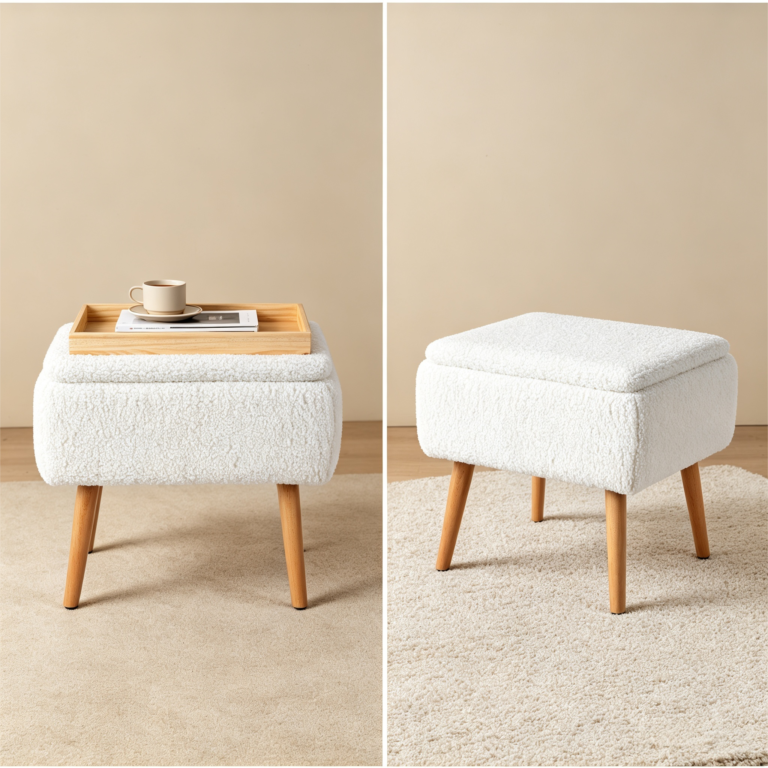
Features a removable wooden serving tray lid and reinforced KD framework for flat-pack container shipping.
View SpecsTrue Ottoman Manufacturing Cost Control extends far beyond the immediate production bill. If a factory delivers a low-cost item that suffers from a 5% consumer return rate due to quality defects, the hidden costs of reverse logistics, customer service administration, and brand damage will completely destroy your profitability.
At FZ Victor, quality control aligns with ISO 9001 Quality Management standards to reinforce Ottoman Manufacturing Cost Control across every sub-station:
FZ Victor is situated in Fuzhou, a prominent hub for industrial furniture production in China. This proximity places us in the center of a dense supply network, minimizing domestic transit costs and ensuring supply chain stability.